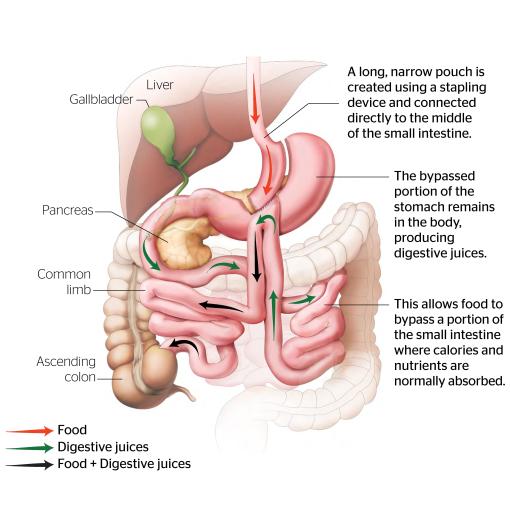
Bile reflux is a recognised complication of one anastomosis gastric bypass (OAGB). Because of the way this operation is constructed, bile can flow back into the stomach pouch more easily than it does after Roux-en-Y gastric bypass (RYGB), although the severity of symptoms and the significance of this vary from patient to patient.
Not every patient with bile in the pouch develops troublesome symptoms. However, some patients experience upper abdominal burning, bitter regurgitation, bilious vomiting, nausea, or inflammation of the gastric pouch or oesophagus. In some cases, bile reflux occurs together with acid reflux, creating a mixed reflux pattern that can be more difficult to diagnose and treat.
Two Types of Gastric Bypass
Many patients say they have had a “gastric bypass” without knowing exactly which type of bypass they had. This is very common, but it matters because the anatomy is different and the risk of bile reflux is different.
There are two main types of gastric bypass:
- Roux-en-Y gastric bypass (RYGB): a small stomach pouch is created and connected to a segment of small bowel, while bile and pancreatic juices are diverted further downstream through a separate limb. This design is intended to keep bile away from the pouch and oesophagus.
- One anastomosis gastric bypass (OAGB): (Also known as mini‑gastric bypass or single‑anastomosis gastric bypass) a long narrow stomach pouch is joined directly to a loop of small bowel with a single connection. Because bile flows through that loop, it can reach the pouch more easily.
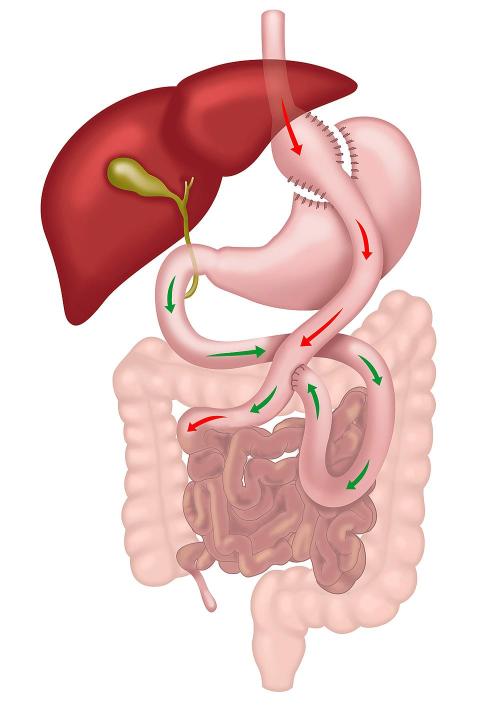
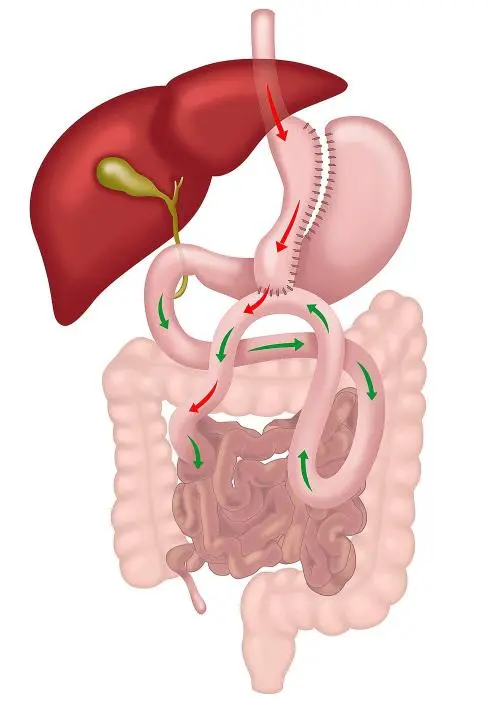
For this reason, bile reflux is mainly a problem of OAGB rather than standard Roux-en-Y gastric bypass. Although rare exceptions have been reported after RYGB, these were associated with unusual anatomy such as an abnormally short alimentary limb and are not typical of a standard Roux-en-Y reconstruction.
What Is Bile Reflux?
Bile is a digestive fluid made by the liver and stored in the gallbladder. It normally flows into the small intestine to help digest fat. Bile reflux happens when bile flows backwards into the stomach pouch and up into the oesophagus.
This is different from standard acid reflux, which is caused by stomach acid going up into the oesophagus. In practice, the distinction is not always simple. Some patients after OAGB have pure bile reflux, while others have mixed bile and acid reflux. This matters because acid-suppressing medicines may help the acid component but do not remove bile from the pouch.
Why Does Bile Reflux Happen After OAGB?
The main reason bile reflux can happen after OAGB is the anatomy of the operation. In OAGB, the stomach pouch is joined to a single loop of small intestine, allowing bile from the intestine to flow back up into the pouch. In contrast, Roux-en-Y gastric bypass separates the bile flow from the food stream using a second intestinal connection, which diverts bile away from the stomach pouch and reduces the risk of reflux.
Several factors may contribute to symptoms:
- The single anastomosis allows bile to reach the gastric pouch and then oesphagus more easily.
- There is no valve at the join to stop backflow.
- The shape or size of the pouch may influence how easily fluid refluxes upwards.
- A hiatus hernia or weak lower oesophageal sphincter may make it easier for bile in the stomach pouch to reach the oesophagus.
- In some patients, there is also an acid component, which can worsen symptoms and mucosal injury.
This is why bile reflux after OAGB is not just a simple “heartburn” problem. It is a complication related to the underlying surgical configuration.
How Common Is Bile Reflux After OAGB?
Reported rates of bile reflux after OAGB vary widely between studies. This is because researchers use different definitions and different tests, including endoscopy, bile reflux scintigraphy, histology, and symptom assessment.
Specialised testing suggests that bile in the gastric pouch is relatively common after OAGB, but bile reflux reaching the oesophagus is much less common.
This distinction is important. A patient may have bile present in the pouch on testing without having major symptoms, while another patient may develop troublesome burning, regurgitation, vomiting, pouch inflammation, or ulcers.
Symptoms of Bile Reflux
Symptoms of bile reflux after OAGB can vary in severity. Some patients have only mild discomfort, while others have persistent symptoms that affect eating and quality of life.
Possible symptoms include:
- Burning pain in the upper abdomen or behind the breastbone
- Bitter or unpleasant fluid coming into the mouth
- Regurgitation or vomiting of green or yellow fluid
- Nausea, especially after eating
- Early fullness or poor tolerance of meals
- Pain or irritation associated with marginal ulcers
- Ongoing symptoms despite standard acid-blocking medication
These symptoms are not specific to bile reflux alone, which is why further testing is often needed.
Mixed Bile and Acid Reflux
Although this article focuses on bile reflux, it is important to recognise that some patients after OAGB have mixed reflux, meaning both bile and acid are contributing to symptoms. This may explain why some patients improve partly with proton pump inhibitors, while others continue to have symptoms despite taking them regularly.
In mixed reflux:
- bile may still be the main anatomical problem
- acid may worsen burning symptoms and mucosal irritation
- treatment may need to address both components
This is one reason the work-up of reflux after OAGB needs to be more careful than simply prescribing long-term acid suppression.
How Is Bile Reflux Diagnosed?
Diagnosis begins with a detailed history. We will want to know what your symptoms feel like, when they happen, whether you vomit bile-stained fluid, and whether acid-blocking medicines have helped.
Tests that may be used include:
- Gastroscopy (endoscopy): to look for bile in the pouch, inflammation, oesophagitis, gastritis, or marginal ulcers.
- Biopsy: to assess for chemical gastritis or other mucosal injury.
- pH-impedance testing: useful when mixed reflux is suspected, because it helps distinguish acid, non-acid, and mixed reflux episodes.
- Bile reflux scintigraphy: a nuclear medicine test that can show bile entering the pouch or oesophagus.
There is no single perfect test, so the diagnosis is usually based on a combination of symptoms, endoscopy findings, and specialised investigations.
Treatment for Bile Reflux After OAGB
Treatment depends on how severe the symptoms are, whether there is mucosal injury, and whether the problem appears to be pure bile reflux or mixed reflux.
Lifestyle and dietary measures
These are often the first step:
- Eat smaller meals
- Eat slowly and chew well
- Avoid lying down soon after eating
- Avoid late meals
- Limit foods and drinks that worsen reflux symptoms
- Stop smoking
- Maintain weight loss where possible
These measures may not solve bile reflux on their own, but they can reduce the overall reflux burden.
Medications
Medication may help some patients, particularly when there is a mixed reflux pattern:
- Proton pump inhibitors (PPIs) may help if acid is also contributing.
- Sucralfate may help protect inflamed tissue or ulcers.
- Other medications are sometimes tried, but the evidence base is limited.
It is important to understand that PPIs do not remove bile, so they are often incomplete treatment for true bile reflux.
When Is Surgery Needed?
Surgery may be considered when symptoms are severe, persistent, or resistant to medical treatment, or when endoscopy shows significant inflammation, ulcers, or damage related to reflux. Revisional surgery is also considered when symptoms have a major effect on nutrition or quality of life.
Conversion to Roux-en-Y gastric bypass
The most established revisional option is conversion from OAGB to Roux-en-Y gastric bypass. This changes the anatomy so that bile is diverted away from the gastric pouch and oesophagus. Reflux is one of the most common reasons for conversion, and bile reflux symptoms generally improve after revision.
Braun anastomosis or bile diversion procedures
In selected cases, some surgeons create a Braun anastomosis, which is a second join between two segments of small bowel below the gastric pouch. This diverts some, but not all, of the bile away from the pouch. It may be considered when the main issue appears to be bile reflux and a full conversion to Roux-en-Y is not planned, although it is not as definitive as full conversion.
The right operation depends on the patient’s anatomy, symptoms, test results, and goals.
Long-Term Considerations
One reason bile reflux receives attention after OAGB is the theoretical concern that long-term exposure of the pouch or oesophagus to bile could be harmful. The available literature suggests that oesophageal bile reflux is uncommon and documented cancer cases directly attributable to OAGB are very rare, but long-term data are still limited.
For that reason, persistent symptoms should be taken seriously. Ongoing bile reflux, recurrent ulcers, or oesophagitis may justify closer follow-up and, in selected patients, further endoscopic surveillance.
Key Takeaways
- There are two main types of gastric bypass: Roux-en-Y gastric bypass and one anastomosis gastric bypass.
- Many patients do not know which type of bypass they had, but this matters when reflux symptoms occur.
- Bile reflux is mainly a problem of OAGB, because its anatomy allows bile to reach the pouch more easily.
- Some patients have pure bile reflux, while others have mixed bile and acid reflux.
- Bile in the gastric pouch may be common on testing, but troublesome symptoms occur in only a subset of patients.
- Diagnosis may involve gastroscopy, biopsy, pH-impedance testing, and bile reflux scintigraphy.
- Mild cases may improve with lifestyle measures and medication, but severe or persistent symptoms may require revisional surgery, often conversion to Roux-en-Y gastric bypass.
Conclusion
Bile reflux is a recognised complication of one anastomosis gastric bypass and is one of the important ways in which OAGB differs from Roux-en-Y gastric bypass. While not every patient with bile exposure develops symptoms, some patients develop significant burning, regurgitation, vomiting, inflammation, or ulceration that deserves proper investigation.
If you have had gastric bypass and are not sure which operation you had, that is an important place to start. Once the anatomy is clear, we can work out whether your symptoms are more likely due to bile reflux, mixed reflux, or another problem, and guide you toward the most appropriate treatment.
References
Keleidari B, Mahmoudieh Dehkordi M, Sayadi Shahraki M, Ahmadi ZS, Heidari M, Hajian A, et al. Bile reflux after one anastomosis gastric bypass surgery: a review study. Ann Med Surg (Lond). 2021;64:102248. doi:10.1016/j.amsu.2021.102248.
Carbajo MA, Luque-de-León E, Jiménez JM, Ortiz-de-Solórzano J, Pérez-Miranda M, Castro-Alija MJ. Bile or acid reflux post one-anastomosis gastric bypass: what must we do? Still an unsolved enigma. J Clin Med. 2022;11(12):3346. doi:10.3390/jcm11123346.
Saarinen T, Pietiläinen KH, Loimaala A, Ihalainen T, Sammalkorpi H, Penttilä A, et al. Once in a bile — the incidence of bile reflux post-bariatric surgery. Obes Surg. 2022;32(6):1769-1778. doi:10.1007/s11695-022-05977-2.
Saarinen T, Pietiläinen KH, Loimaala A, Ihalainen T, Sammalkorpi H, Penttilä A, et al. Bile reflux is a common finding in the gastric pouch after one anastomosis gastric bypass. Obes Surg. 2020;30(3):875-881. doi:10.1007/s11695-019-04353-x.
Kassir R, Petrucciani N, Debs T, Juglard G, Martini F, Liagre A, et al. Conversion of one anastomosis gastric bypass (OAGB) to Roux-en-Y gastric bypass for biliary reflux resistant to medical treatment: lessons learned from a retrospective series of 2780 consecutive patients undergoing OAGB. Obes Surg. 2020;30(6):2093-2098. doi:10.1007/s11695-020-04460-0.
Brown WA, Johari Halim Shah Y, Balalis G, Bashir A, Ramos A, Kow L, et al. Outcomes of one-anastomosis gastric bypass conversion to Roux-en-Y gastric bypass: a systematic review. Obes Surg. 2024;34(3):1020-1028. doi:10.1007/s11695-023-07071-7.
Musella M, Milone M, Vitiello A, Bianco P, Musella S, Berardi G, et al. Bile reflux and marginal ulcers after one-anastomosis gastric bypass (OAGB): a narrative review. Cir Esp (Engl Ed). 2024;102(2):79-86. doi:10.1016/j.cireng.2023.08.012.
Jones KB Jr, Afram JD, Benotti PN, Capella JF, Kelly KA. Bile reflux after Roux-en-Y gastric bypass: an unrecognized cause of postoperative pain. Surg Obes Relat Dis. 2009;5(1):27-30. doi:10.1016/j.soard.2008.09.003.